Phrases That Read the Same Forward and Backward
A palindrome is a word, number, phrase, or other sequence of characters which reads the aforementioned backward as forward, such every bit madam or racecar. At that place are also numeric palindromes, including engagement/time stamps using short digits 11/xi/11 11:11 and long digits 02/02/2020. For instance; Tuesday, 22 February 2022 is considered a palindrome mean solar day (22022022 using dd-mm-yyyy format) as it can be read from left to correct or vice versa. Sentence-length palindromes ignore capitalization, punctuation, and word boundaries.
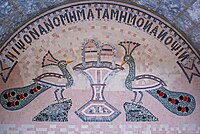
Composing literature in palindromes is an instance of constrained writing.
The give-and-take palindrome was introduced by Henry Peacham in 1638.[1] It is derived from the Greek roots πάλιν 'again' and δρóμος 'way, management'; a different give-and-take is used in Greek, καρκινικός 'carcinic' (lit. crab-like) to refer to letter-by-letter reversible writing.[two] [3]
History [edit]
The ancient Greek poet Sotades (third century BCE) invented a form of Ionic meter called Sotadic or Sotadean verse, which is sometimes said to accept been palindromic,[4] but no examples survive,[5] and the exact nature of the "reverse" readings is unclear.[6] [seven] [eight]

A palindrome was institute as a graffito at Herculaneum, a urban center buried past ash in 79 CE. This palindrome, called the Sator Foursquare, consists of a sentence written in Latin: "Sator Arepo Tenet Opera Rotas" ("The sower Arepo holds with endeavour the wheels"). It is remarkable for the fact that the start messages of each word class the first word, the second messages form the second word, and so forth. Hence, it tin be bundled into a give-and-take square that reads in iv different means: horizontally or vertically from either acme left to lesser right or bottom right to superlative left. As such, they tin can be referred to equally palindromatic.[ commendation needed ]
A palindrome with the same square belongings is the Hebrew palindrome, "We explained the glutton who is in the honey was burned and incinerated", (פרשנו רעבתן שבדבש נתבער ונשרף; perashnu: ra`avtan shebad'vash nitba`er venisraf), credited to Abraham ibn Ezra in 1924,[9] and referring to the halachic question as to whether a fly landing in honey makes the dear treif (not-kosher).
The palindromic Latin riddle "In girum imus nocte et consumimur igni" ("nosotros go in a circle at night and are consumed by fire") describes the behavior of moths. It is likely that this palindrome is from medieval rather than aboriginal times. The second discussion, borrowed from Greek, should properly be spelled gyrum.
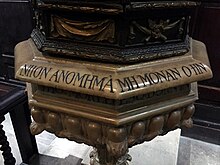
Byzantine baptismal fonts were oftentimes inscribed with the palindrome, ΝΙΨΟΝ ΑΝΟΜΗΜΑΤΑ ΜΗ ΜΟΝΑΝ ΟΨΙΝ ("Nipson anomēmata mē monan opsin") 'Wash [your] sins, non only [your] face up', attributed to Gregory of Nazianzus;[5] most notably in the basilica of Hagia Sophia in Constantinople. A variant, also a palindrome, replaces the plural ΑΝΟΜΗΜΑΤΑ ("sins") past the singular ΑΝΟΜΗΜΑ ("sin"). The inscription is found on fonts in many churches in Western Europe: Orléans (St. Menin's Abbey); Dulwich College; Nottingham (St. Mary's); Worlingworth; Harlow; Knapton; London (St Martin, Ludgate); and Hadleigh (Suffolk).
A Greek poet in 1802 Vienna even composed a verse form, Ποίημα Καρκινικόν (Carcinic Poem), in Ancient Greek, where every 1 of the 455 lines was a palindrome.[10] [xi]
In English, there are dozens of palindrome words, such as eye, madam, and deified, simply English language writers generally only cited Latin and Greek palindromic sentences in the early 19th century,[12] even though John Taylor had coined i in 1614: "Lewd did I live, & evil I did dwel" (with the ampersand being something of a "fudge"[13]). This is more often than not considered to be the start English-linguistic communication palindrome sentence, and was long reputed (notably by the grammarian James "Hermes" Harris) to be the simply 1, despite many efforts to find others.[ten] [14] (Taylor had also equanimous two other, "rather indifferent", palindromic lines of poesy: "Deer Madam, Reed", "Deem if I meed".[four]) So in 1848, a certain "J.T.R." coined "Able was I ere I saw Elba", which became famous after it was (implausibly) attributed to Napoleon.[15] [14]
In recent history, there have been competitions related to palindromes, such as the 2012 Earth Palindrome Championship, set up in Brooklyn, USA.[16]
Some well-known English palindromes are, "Able was I ere I saw Elba" (1848),[17] [18] "A human, a programme, a canal – Panama" (1948),[19] "Madam, I'm Adam" (1861),[20] and "Never odd or even".
English palindromes of notable length include mathematician Peter Hilton's "Doctor, note: I dissent. A fast never prevents a fatness. I diet on cod"[21] and Scottish poet Alastair Reid's "T. Eliot, height bard, notes putrid tang emanating, is sad; I'd assign it a name: gnat dirt upset on drab pot toilet."[22]
Types [edit]
Characters, words, or lines [edit]
The nigh familiar palindromes in English are character-unit palindromes. The characters read the same astern equally forward. Some examples of palindromic words are redivider, deified, borough, radar, level, rotor, kayak, reviver, racecar, madam, and refer.
There are also word-unit of measurement palindromes in which the unit of reversal is the discussion ("Is it crazy how saying sentences backwards creates backwards sentences proverb how crazy information technology is?"). Discussion-unit palindromes were fabricated popular in the recreational linguistics community by J. A. Lindon in the 1960s. Occasional examples in English language were created in the 19th century. Several in French and Latin engagement to the Middle Ages.[23]
There are besides line-unit palindromes, most often poems. These possess an initial set of lines which, precisely halfway through, is repeated in opposite guild, without alteration to word order within each line, and in a manner that the second half continues the "story" related in the first one-half in a mode that makes sense, this last existence key.[24]
Sentences and phrases [edit]

Ambigram of the palindrome "Dogma I am God"
Palindromes often consist of a sentence or phrase, due east.g., "Mr. Owl ate my metal worm", "Do geese encounter God?", or "Was it a automobile or a true cat I saw?". Punctuation, capitalization, and spaces are usually ignored. Some, such equally "Rats live on no evil star", "Live on time, emit no evil", and "Pace on no pets", include the spaces.
Names [edit]
Some names are palindromes, such as the given names Hannah, Ava, Aviva, Anna, Eve, Bob and Otto, or the surnames Harrah, Renner, Salas, and Nenonen. Lon Nol (1913–1985) was Prime Government minister of Cambodia. Nisio Isin is a Japanese novelist and manga writer, whose pseudonym (西尾 維新, Nishio Ishin) is a palindrome when romanized using the Kunrei-shiki or the Nihon-shiki systems, and is often written every bit NisiOisiN to emphasize this. Some people have changed their name in order to make it palindromic (such as player Robert Trebor and rock-vocalist Ola Salo), while others were given a palindromic name at birth (such equally the philologist Revilo P. Oliver, the flamenco dancer Sara Baras, the runner Anuța Cătună, the sportswriter Mark Kram and the creator of the Eden Project Tim Smit).
There are besides palindromic names in fictional media. "Stanley Yelnats" is the proper name of the main character in Holes, a 1998 novel and 2003 film. Iv of the fictional Pokémon species have palindromic names in English language (Eevee, Girafarig, Ho-Oh, and Alomomola) while the region Alola is also a palindrome.
The 1970s popular band ABBA is a palindrome using the starting letter of the first name of each of the four band members.
Numbers [edit]
The digits of a palindromic number are the same read backwards equally forrard, for example, 91019; decimal representation is usually causeless. In recreational mathematics, palindromic numbers with special properties are sought. For instance, 191 and 313 are palindromic primes.
Whether Lychrel numbers exist is an unsolved trouble in mathematics about whether all numbers become palindromes when they are continuously reversed and added. For example, 56 is not a Lychrel number every bit 56 + 65 = 121, and 121 is a palindrome. The number 59 becomes a palindrome after three iterations: 59 + 95 = 154; 154 + 451 = 605; 605 + 506 = 1111, and so 59 is non a Lychrel number either. Numbers such as 196 are thought to never go palindromes when this reversal process is carried out and are therefore suspected of being Lychrel numbers. If a number is non a Lychrel number, it is called a "delayed palindrome" (56 has a delay of 1 and 59 has a delay of 3). In January 2017 the number 1,999,291,987,030,606,810 was published in OEIS every bit A281509, and described as "The Largest Known Nearly Delayed Palindrome", with a filibuster of 261. Several smaller 261-filibuster palindromes were published separately as A281508.
Every positive integer can be written as the sum of 3 palindromic numbers in every number organisation with base 5 or greater.[25]
The continued fraction of √ northward + ⌊√ n ⌋ is a repeating palindrome[ definition needed ] when due north is an integer, where ⌊x⌋ denotes the integer function of 10.[ citation needed ]
Dates [edit]
A day or timestamp is a palindrome when its digits are the aforementioned when reversed. But the digits are considered in this conclusion and the component separators (hyphens, slashes, and dots) are ignored. Short digits may exist used as in xi/11/11 eleven:11 or long digits equally in 2 February 2020.
A notable palindrome solar day is this century's 2 February 2020 because this date is a palindrome regardless of the date format by country (yyyy-mm-dd, dd-mm-yyyy, or mm-dd-yyyy) used in various countries. For this reason, this date has likewise been termed as a "Universal Palindrome Solar day".[26] [27] Other universal palindrome days include, almost a millennium previously, xi/11/1111, the futurity 12/12/2121, and in a millennium 03/03/3030.[28]
In speech [edit]
A phonetic palindrome is a portion of speech that is identical or roughly identical when reversed. It tin ascend in context where language is played with, for example in slang dialects like verlan.[29] In the French language, at that place is the phrase une Slave valse nue ("a Slavic woman waltzes naked"), phonemically /yn slav vals ny/ .[xxx] John Oswald discussed his feel of phonetic palindromes while working on audio tape versions of the cutting-up technique using recorded readings past William S. Burroughs.[31] [32] A listing of phonetic palindromes discussed past give-and-take puzzle columnist O.5. Michaelsen (Ove Ofteness) include "crew work"/"piece of work crew", "dry yard", "easy", "Funny enough", "Allow Bob tell", "new moon", "selfless", "Distressing, Ross", "Talk, Scott", "to kick", "top spot" (also an orthographic palindrome), "Y'all lie", "You're defenseless. Talk, Roy", and "You're damn mad, Roy".[33]
Classical music [edit]

Centre part of palindrome in Alban Berg's opera Lulu
Joseph Haydn'south Symphony No. 47 in G is nicknamed "the Palindrome". In the tertiary movement, a minuet and trio, the 2nd half of the minuet is the same as the outset but backwards, the second half of the ensuing trio similarly reflects the commencement half, and then the minuet is repeated.
The interlude from Alban Berg'south opera Lulu is a palindrome,[34] as are sections and pieces, in curvation form, past many other composers, including James Tenney, and most famously Béla Bartók. George Nibble besides used musical palindrome to text paint the Federico García Lorca poem "¿Por qué nací?", the kickoff movement of three in his fourth book of Madrigals. Igor Stravinsky's final composition, The Owl and the Pussy True cat, is a palindrome.[35] [ unreliable source? ]
The first movement from Constant Lambert's ballet Horoscope (1938) is entitled "Palindromic Prelude". Lambert claimed that the theme was dictated to him by the ghost of Bernard van Dieren, who had died in 1936.[36] [ unreliable source? ]
British composer Robert Simpson also composed music in the palindrome or based on palindromic themes; the boring movement of his Symphony No. 2 is a palindrome, as is the dull move of his String Quartet No. 1. His hour-long String Quartet No. 9 consists of xxx-ii variations and a fugue on a palindromic theme of Haydn (from the minuet of his Symphony No. 47). All of Simpson's thirty-two variations are themselves palindromic.
Hin und Zurück ("There and Back": 1927) is an operatic 'sketch' (Op. 45a) in one scene by Paul Hindemith, with a German libretto by Marcellus Schiffer. It is essentially a dramatic palindrome. Through the offset one-half, a tragedy unfolds betwixt two lovers, involving jealousy, murder and suicide. So, in the reversing second half, this is replayed with the lines sung in contrary club to produce a happy ending.
The music of Anton Webern is ofttimes palindromic. Webern, who had studied the music of the Renaissance composer Heinrich Isaac, was extremely interested in symmetries in music, be they horizontal or vertical. An example of horizontal or linear symmetry in Webern's music is the first phrase in the second motion of the symphony, Op. 21. A striking example of vertical symmetry is the 2nd motion of the Piano Variations, Op. 27, in which Webern arranges every pitch of this dodecaphonic piece of work around the cardinal pitch axis of A4. From this, each downward reaching interval is replicated exactly in the reverse management. For example, a Chiliad ♯ 3—13 half-steps down from A4 is replicated equally a B ♭ 5—13 one-half-steps above.
Merely as the messages of a verbal palindrome are non reversed, so are the elements of a musical palindrome usually presented in the same form in both halves. Although these elements are usually single notes, palindromes may be made using more circuitous elements. For case, Karlheinz Stockhausen's limerick Mixtur, originally written in 1964, consists of twenty sections, chosen "moments", which may be permuted in several different means, including retrograde presentation, and ii versions may exist made in a single program. When the composer revised the work in 2003, he prescribed such a palindromic performance, with the twenty moments first played in a "forwards" version, and and then "backwards". Each moment, nonetheless, is a complex musical unit, and is played in the same direction in each half of the program.[37] Past contrast, Karel Goeyvaerts'southward 1953 electronic composition, Nummer v (met zuivere tonen) is an exact palindrome: not simply does each event in the second half of the piece occur according to an axis of symmetry at the centre of the piece of work, but each event itself is reversed, and then that the note attacks in the first half become note decays in the second, and vice versa. Information technology is a perfect example of Goeyvaerts's aesthetics, the perfect example of the imperfection of perfection.[38]
In classical music, a crab canon is a canon in which ane line of the melody is reversed in time and pitch from the other. A large-scale musical palindrome covering more than ane motion is called "chiastic", referring to the cross-shaped Greek letter of the alphabet "χ" (pronounced /ˈkaɪ/.) This is usually a form of reference to the crucifixion; for example, the Crucifixus movement of Bach's Mass in B minor. The purpose of such palindromic balancing is to focus the listener on the central motility, much as one would focus on the eye of the cross in the crucifixion. Other examples are found in Bach's cantata BWV iv, Christ lag in Todes Banden, Handel's Messiah and Fauré'southward Requiem.[39]
A tabular array canon is a rectangular piece of sheet music intended to be played by two musicians facing each other across a table with the music between them, with one musician viewing the music upside downward compared to the other. The upshot is somewhat similar two speakers simultaneously reading the Sator Square from reverse sides, except that it is typically in two-role polyphony rather than in unison.[ citation needed ]
Long palindromes [edit]
The longest palindromic word in the Oxford English language Dictionary is the onomatopoeic tattarrattat, coined by James Joyce in Ulysses (1922) for a knock on the door.[xl] [41] The Guinness Volume of Records gives the title to detartrated, the preterite and past participle of detartrate, a chemical term meaning to remove tartrates. Rotavator, a trademarked name for an agricultural machine, is often listed in dictionaries. The term redivider is used by some writers, but appears to be an invented or derived term—only redivide and redivision appear in the Shorter Oxford Dictionary. Malayalam, a language of southern India, is of equal length.
In English, 2 palindromic novels have been published: Satire: Veritas by David Stephens (1980, 58,795 letters), and Dr Awkward & Olson in Oslo by Lawrence Levine (1986, 31,954 words).[42] Another palindromic English work is a 224-word long poem, "Dammit I'grand Mad", written by Demetri Martin.[43] "Weird Al" Yankovic's song "Bob" is equanimous entirely of palindromes.[44]
Co-ordinate to Guinness World Records, the Finnish 19-alphabetic character give-and-take saippuakivikauppias (a soapstone vendor), is the world'due south longest palindromic give-and-take in everyday use.[45]
Biological structures [edit]

In nigh genomes or sets of genetic instructions, palindromic motifs are plant. The significant of palindrome in the context of genetics is slightly different, yet, from the definition used for words and sentences. Since the Deoxyribonucleic acid is formed past two paired strands of nucleotides, and the nucleotides e'er pair in the same style (Adenine (A) with Thymine (T), Cytosine (C) with Guanine (G)), a (single-stranded) sequence of Deoxyribonucleic acid is said to be a palindrome if it is equal to its complementary sequence read astern. For example, the sequence ACCTAGGT is palindromic considering its complement is TGGATCCA, which is equal to the original sequence in reverse complement.
A palindromic DNA sequence may form a hairpin. Palindromic motifs are made by the order of the nucleotides that specify the complex chemicals (proteins) that, as a outcome of those genetic instructions, the prison cell is to produce. They have been especially researched in bacterial chromosomes and in the so-called Bacterial Interspersed Mosaic Elements (BIMEs) scattered over them. Recently[ when? ] a enquiry genome sequencing project discovered that many of the bases on the Y-chromosome are arranged equally palindromes.[46] A palindrome construction allows the Y-chromosome to repair itself by bending over at the middle if one side is damaged.
It is believed that palindromes often are also institute in proteins,[47] [48] merely their function in the protein function is not clearly known. It has recently[49] been suggested that the prevalence beingness of palindromes in peptides might be related to the prevalence of low-complication regions in proteins, as palindromes frequently are associated with low-complexity sequences. Their prevalence might likewise exist related to an alpha helical formation propensity of these sequences,[49] or in formation of proteins/protein complexes.[50]
Computation theory [edit]
In automata theory, a set of all palindromes in a given alphabet is a typical example of a language that is context-costless, but not regular. This means that it is incommunicable for a calculator with a finite amount of memory to reliably test for palindromes. (For practical purposes with modern computers, this limitation would utilize only to impractically long letter-sequences.)
In addition, the prepare of palindromes may not exist reliably tested by a deterministic pushdown automaton which also means that they are non LR(k)-parsable or LL(k)-parsable. When reading a palindrome from left-to-right, it is, in essence, impossible to locate the "middle" until the entire give-and-take has been read completely.
Information technology is possible to find the longest palindromic substring of a given input string in linear fourth dimension.[51] [52]
The palindromic density of an infinite word westward over an alphabet A is divers to be zero if but finitely many prefixes are palindromes; otherwise, letting the palindromic prefixes be of lengths n k for k=one,2,... we define the density to be
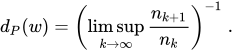
Among aperiodic words, the largest possible palindromic density is accomplished by the Fibonacci word, which has density 1/φ, where φ is the Golden ratio.[53]
A palstar is a concatenation of palindromic strings, excluding the trivial one-letter of the alphabet palindromes – otherwise all strings would be palstars.[51]
Notable palindromists [edit]
- Dmitry Avaliani (1938–2003)
- Howard Bergerson (1922–2011)
- Hugo Brandt Corstius (1935–2014) symmys
- Simo Frangén (b. 1963)
- Pasi Heikura (b. 1963)
- Velimir Khlebnikov (1885–1922)
- J. A. Lindon (built-in c. 1914–1979)
- Leigh Mercer (1893–1977) all-time known for devising the palindrome "A man, a programme, a canal: Panama!"
- Georges Perec (1936–1982)
- Mark Saltveit (b. 1961)
- Anthony Etherin (b. 1981)
- Su Hui (poet) (unknown nascence and decease dates)
- Babe Granddad (unknown birth appointment)
See also [edit]
- Ambigram
- Anagram
- Ananym
- Anastrophe, different word order
- Antimetabole
- Backmasking
- Chiasmus
- Constrained writing
- Crab canon
- Eodermdrome
- "I Palindrome I" by They Might Be Giants
- List of palindromic places
- Mirror writing
- Palindroma, a genus of spiders with palindromic species names
- Palindromic number
- Palindromic polynomial
- Pangram
- Yreka, California for the palindromic Yreka Bakery and Yrella Gallery
References [edit]
- ^ Henry Peacham, The Truth of our Times Revealed out of I Mans Experience, 1638, p. 123
- ^ Triantaphylides Lexicon, Portal for the Greek Language. "Combined word search for καρκινικός". www.greek-language.gr . Retrieved 6 May 2019.
- ^ William Martin Leake, Researches in Greece, 1814, p. 85
- ^ a b H.B. Wheatley, Of Anagrams: A Monograph Treating of Their History from the Earliest Ages..., London, 1862, p. ix-11
- ^ a b Alex Preminger, ed., Princeton Encyclopedia of Poetry and Poetics, 1965, JSTOR j.ctt13x0qvn, south.v. 'palindrome', p. 596
- ^ January Kwapisz, The Paradign of Simias: Essays on Poetic Eccentricity, p. 62-68
- ^ Alex Preminger, ed., Princeton Encyclopedia of Poesy and Poetics, 1965, JSTOR j.ctt13x0qvn, s.5. 'Sotadean', p. 784
- ^ The Century Lexicon, 1889, s.v. 'Sotadic', p. five:5780. "Sotadic verse... A palindromic poesy; so named apparently from some aboriginal examples of Sotadean verse existence palindromic."
- ^ Soclof, Adam (28 Dec 2011). "Jewish Wordplay". Jewish Telegraphic Agency . Retrieved 21 November 2016.
- ^ a b "On Palindromes" The New Monthly Mag 2:170-173 (July–December 1821)
- ^ Αμβρόσιος Ιερομόναχος του Παμπέρεως (Hieromonk Ambrosios Pamperis), Ποίημα Καρκινικόν, Vienna, 1802 full text
- ^ S(ilvanus) Urban, "Classical Literature: On Macaronic Poetry", The Gentleman'south Magazine, or Monthly Intelligencer, London, 100:part ii:34-36 (New Series 23) (July 1830)
- ^ Richard Lederer, The Give-and-take Circus: A Letter-perfect Book, 1998, ISBN 0877793549, p.54
- ^ a b "Ingenious Arrangement of Words", The Gazette of the Union, Gold Rule, and Odd Fellows' Family Companion 9:30 (July 8, 1848)
- ^ "Able Was I Ere I Saw Elba", Quote Investigator September xv, 2013
- ^ Steinmetz, Katy (four Apr 2015). ""Madam, I'chiliad Adam": Meet the World Palindrome Champion". Time . Retrieved 2 Feb 2020.
- ^ Alluding to the first exile of Napoleon to Elba
- ^ "Doings in Baltimore". Gazette of the union, gilt rule and Odd-fellows' family companion. ix (2): 30. July eight, 1848.
- ^ By Leigh Mercer, published in Notes and Queries, 13 November 1948, according to The Yale Book of Quotations, F. R. Shapiro, ed. (2006, ISBN 0-300-10798-six).
- ^ Exercise you give it upwards?: A collection of the most amusing conundrums, riddles, etc. of the day, London, 1861, p. 4
- ^ "Professor Peter Hilton". Daily Telegraph. London. 10 November 2010. Retrieved 30 Apr 2011.
- ^ Past Brendan Gill, published in Here At The New Yorker, (1997, ISBN 0-306-80810-2).
- ^ Mark J. Nelson (7 February 2012). "Word-unit palindromes". Retrieved 18 November 2012.
- ^ "Never Odd Or Even, and Other Tricks Words Can Do" by O.V. Michaelsen (Sterling Publishing Company: New York), 2005 p124-7
- ^ Cilleruelo, Javier; Luca, Florian; Baxter, Lewis (19 February 2016). "Every positive integer is a sum of iii palindromes". arXiv:1602.06208 [math.NT].
- ^ "Universal Palindrome Twenty-four hours". 2 Feb 2020.
- ^ "#PalindromeDay: Geeks around the globe celebrate 02/02/2020". BBC. 2 February 2020.
- ^ Held, Amy (two February 2020). "Why A Day Like Sunday Hasn't Been Seen In 900 Years". NPR.
- ^ Goertz, Karein One thousand. (2003). "Showing Her Colors: An Afro-German Writes the Blues in Blackness and White". Callaloo. 26 (ii): 306–319. doi:10.1353/cal.2003.0045. JSTOR 3300855. S2CID 161346520.
- ^ Durand, Gerard (2003). Palindromes en Folie. Les Dossiers de l'Aquitaine. p. 32. ISBN978-2846220361.
- ^ "Section titled "On Burroughs and Burrows ..."". Pfony.com. Retrieved 23 April 2012.
- ^ Reversible audio cut-ups of William S. Burroughs' vocalization, including an audio-visual palindrome in instance 5 (requires Flash)
- ^ Michaelsen, O.V. (1998). Words at play: quips, quirks and oddities. Sterling.
- ^ "Lulu". British Library . Retrieved 2021-08-07 .
- ^ A helpful listing is at http://deconstructing-jim.blogspot.com/2010/03/musical-palindromes.html
- ^ "Answers.com". Answers.com. Retrieved 23 April 2012.
- ^ Rudolf Frisius, Karlheinz Stockhausen II: Dice Werke 1950–1977; Gespräch mit Karlheinz Stockhausen, "Es geht aufwärts" (Mainz, London, Berlin, Madrid, New York, Paris, Prague, Tokyo, Toronto: Schott Musik International, 2008): 164–65. ISBN 978-3-7957-0249-6.
- ^ M[orag] J[osephine] Grant, Series Music, Series Aesthetics: Compositional Theory in Post-state of war Europe (Cambridge, U.One thousand.; New York: Cambridge University Printing, 2001): 64–65.
- ^ Charton, Shawn E. Jennens vs. Handel: Decoding the Mysteries of Messiah.
- ^ James Joyce (1982). Ulysses. Editions Artisan Devereaux. pp. 434–. ISBN978-ane-936694-38-9.
...I was just kickoff to yawn with fretfulness thinking he was trying to make a fool of me when I knew his tattarrattat at the door he must ...
- ^ O.A. Booty (1 January 2002). Funny Side of English. Pustak Mahal. pp. 203–. ISBN978-81-223-0799-3.
The longest palindromic word in English language has 12 letters: tattarrattat. This word, appearing in the Oxford English Dictionary, was invented past James Joyce and used in his book Ulysses (1922), and is an imitation of the sound of someone ...
- ^ Eckler, Ross (1996). Making the Alphabet Trip the light fantastic. NY: St. Martin's. p. 36. ISBN978-0-333-90334-vi.
- ^ "Demetri Martin's Palindrome". Yale University. Mathematics Department. Archived from the original on 29 June 2010. Retrieved 17 February 2014.
- ^ Twardzik, Tom (2016-10-25). "Celebrate Bob Dylan's Nobel with Weird Al". Popdust . Retrieved xv June 2021.
- ^ "Longest palindromic word". Guinness Earth Records. Retrieved 12 January 2017.
- ^ "2003 Release: Machinery Preserves Y Chromosome Gene". National Man Genome Research Plant (NHGRI) . Retrieved 21 Nov 2017.
- ^ Ohno S (1990). "Intrinsic evolution of proteins. The role of peptidic palindromes". Riv. Biol. 83 (2–three): 287–91, 405–10. PMID 2128128.
- ^ Giel-Pietraszuk M, Hoffmann M, Dolecka S, Rychlewski J, Barciszewski J (Feb 2003). "Palindromes in proteins". J. Protein Chem. 22 (2): 109–13. doi:10.1023/A:1023454111924. PMID 12760415. S2CID 28294669. Archived from the original (PDF) on 2019-12-fourteen. Retrieved 2011-02-17 .
- ^ a b Sheari A, Kargar One thousand, Katanforoush A, et al. (2008). "A tale of two symmetrical tails: structural and functional characteristics of palindromes in proteins". BMC Bioinformatics. ix: 274. doi:10.1186/1471-2105-9-274. PMC2474621. PMID 18547401.
- ^ Pinotsis North, Wilmanns M (October 2008). "Protein assemblies with palindromic structure motifs". Cell. Mol. Life Sci. 65 (19): 2953–6. doi:x.1007/s00018-008-8265-1. PMID 18791850. S2CID 29569626.
- ^ a b Crochemore, Maxime; Rytter, Wojciech (2003), "8.one Searching for symmetric words", Jewels of Stringology: Text Algorithms, World Scientific, pp. 111–114, ISBN978-981-02-4897-0
- ^ Gusfield, Dan (1997), "9.2 Finding all maximal palindromes in linear time", Algorithms on Strings, Copse, and Sequences, Cambridge: Cambridge Academy Press, pp. 197–199, doi:x.1017/CBO9780511574931, ISBN978-0-521-58519-4, MR 1460730
- ^ Adamczewski, Boris; Bugeaud, Yann (2010), "viii. Transcendence and diophantine approximation", in Berthé, Valérie; Rigo, Michael (eds.), Combinatorics, automata, and number theory, Encyclopedia of Mathematics and its Applications, vol. 135, Cambridge: Cambridge University Press, p. 443, ISBN978-0-521-51597-9, Zbl 1271.11073
Farther reading [edit]
- Discussion Ways: The Journal of Recreational Linguistics. Greenwood Periodicals et al., 1968–. ISSN 0043-7980.
- The Palindromist. Palindromist Press, 1996–.
- Howard Westward. Bergerson. Palindromes and Anagrams. Dover Publications, 1973. ISBN 978-0486206646.
- Dmitri A.Borgman. Linguistic communication on Vacation. Charles Scribner'south Sons, 1965. ISBN 978-0006523086
- Stephen J. Chism. From A to Zotamorf: The Lexicon of Palindromes. Word Means Press, 1992. ISBN 978-0963515209.
- Michael Donner. I Love Me, Vol. I: S. Wordrow'due south Palindrome Encyclopedia. Algonquin Books, 1996. ISBN 978-1565121096.
External links [edit]
- Chisholm, Hugh, ed. (1911). . Encyclopædia Britannica. Vol. 20 (11th ed.). Cambridge Academy Press. p. 633.
- "Palindromes". Several languages. European Day of Languages (EDL).
Celebrated Sep 26
Source: https://en.wikipedia.org/wiki/Palindrome
0 Response to "Phrases That Read the Same Forward and Backward"
Post a Comment