Can Caliper Read Both English and Metric ?

A caliper (British spelling also calliper, or in plurale tantum sense a pair of calipers) is a device used to measure the dimensions of an object.
Many types of calipers permit reading out a measurement on a ruled calibration, a punch, or a digital display. Some calipers can be as unproblematic as a compass with inward or outward-facing points, but no scale. The tips of the caliper are adjusted to fit beyond the points to exist measured and the dimension read past measuring between the tips with another measuring tool, such equally a ruler.
It is used in many fields such equally mechanical engineering science, metalworking, forestry, woodworking, scientific discipline and medicine.
Plural vs. singular [edit]
A single tool might exist referred to equally a "caliper" or as "calipers", like a pair of pair of scissors or glasses (a "plural merely" or plurale tantum grade). In colloquial usage, the phrase "pair of verniers" or just "vernier" might refer to a vernier caliper. Colloquially these phrases can likewise refer to dial calipers, although they involve no vernier scale.
In machine-shop usage, the term "caliper" is oft used in contradistinction to "micrometer", even though exterior micrometers are technically a course of caliper. In this usage, "caliper" implies but the form factor of the vernier or dial caliper (or its digital counterpart).
History [edit]
The earliest caliper has been found in the Greek Giglio wreck near the Italian declension. The ship's observe dates to the 6th century BC. The wooden piece already featured a fixed and a movable jaw.[1] [ii] Although rare finds, calipers remained in apply past the Greeks and Romans.[2] [iii]
A bronze caliper, dating from 9 AD, was used for infinitesimal measurements during the Chinese Xin dynasty. The caliper had an inscription stating that it was "made on the gui-you day[a], the commencement 24-hour interval[b] of the first month of the first year of Shijianguo [c]." The calipers included a "slot and pivot" and "graduated in inches and tenths of an inch."[4] [5]

Calliper with graduated bow 0–10 mm
The modern vernier caliper was invented past Pierre Vernier, as an improvement of the nonius of Pedro Nunes.
Types [edit]
Inside calliper [edit]

The inside callipers are used to measure the internal size of an object.
- The upper caliper in the image (on the right) requires manual adjustment prior to fitting. Fine setting of this caliper type is performed by borer the caliper legs lightly on a handy surface until they volition nearly laissez passer over the object. A light button against the resistance of the cardinal pivot screw so spreads the legs to the right dimension and provides the required, consistent feel that ensures a repeatable measurement.
- The lower caliper in the image has an adjusting screw that permits it to be advisedly adapted without removal of the tool from the workpiece.
Outside caliper [edit]

Outside callipers are used to measure the external size of an object.
The aforementioned observations and technique apply to this type of caliper, as for the inside caliper. With some agreement of their limitations and usage, these instruments can provide a high caste of accuracy and repeatability. They are especially useful when measuring over very large distances; consider if the calipers are used to measure a large diameter pipe. A vernier caliper does not have the depth capacity to straddle this large diameter and at the same fourth dimension reach the outermost points of the pipe's diameter. They are made from high carbon steel.
Divider calliper [edit]
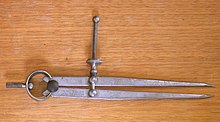
In the metalworking field, a divider caliper, popularly chosen a compass, is used to mark out locations. The points are sharpened and so that they act as scribers; one leg tin can and so be placed in the dimple created by a eye or prick punch and the other leg pivoted so that it scribes a line on the workpiece's surface, thus forming an arc or circle.
A divider caliper is also used to mensurate a distance between ii points on a map. The two caliper ends are brought to the 2 points whose distance is being measured. The caliper's opening is then either measured on a separate ruler and and so converted to the bodily altitude, or measured directly on a scale drawn on the map. On a chart the distance is frequently measured on the latitude scale appearing on the sides of the map: 1 minute of arc along whatever great circle, e.1000. any longitude top, is approximately one nautical mile or 1852 meters.
Dividers are also used in the medical profession. An ECG (also EKG) caliper transfers distance on an electrocardiogram; in conjunction with the appropriate scale, the center charge per unit can exist determined. A pocket caliper version was invented by cardiologist Robert A. Mackin.[half dozen] [ failed verification ]
Oddleg caliper [edit]

Oddleg calipers, Hermaphrodite calipers, or Oddleg Jennys, equally pictured on the left, are mostly used to scribe a line at a set altitude from the edge of a workpiece. The bent leg is used to run along the workpiece border while the scriber makes its mark at a predetermined distance, this ensures a line parallel to the border.
In the diagram at left, the uppermost caliper has a slight shoulder in the bent leg allowing it to sit on the edge more securely. The lower caliper lacks this feature but has a renewable scriber that can be adjusted for habiliment, every bit well as beingness replaced when excessively worn.
Vernier caliper [edit]
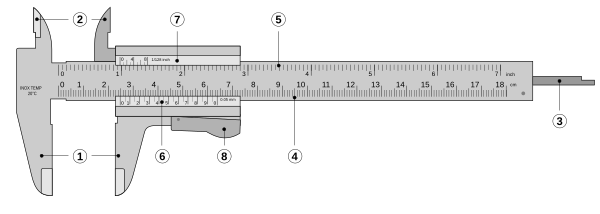
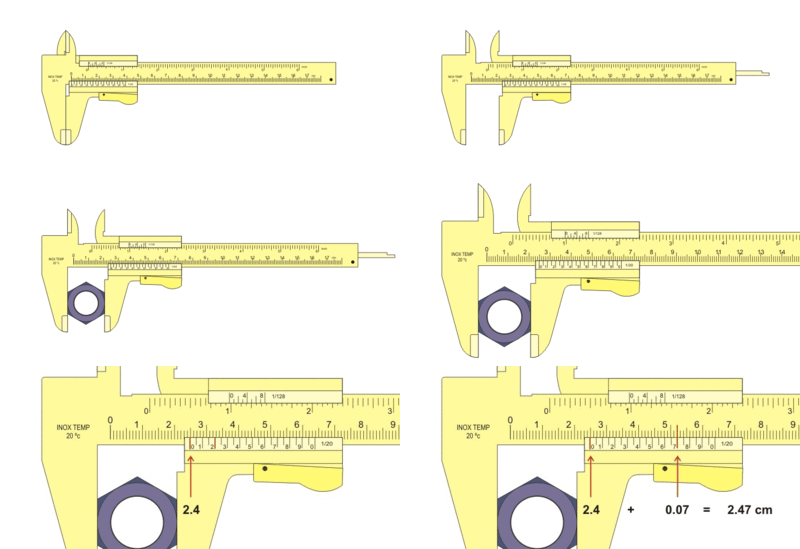
Diagram of vernier callipers.
The labelled parts are
- Outside large jaws: used to measure external diameter of an object (like a hollow cylinder) or width of an object (like a rod), bore of an object (like a sphere).
- Inside small jaws: used to measure the internal bore of an object (like a hollow cylinder or pipe).
- Depth probe/rod: used to measure depths of an object (like a pocket-size beaker) or a hole.
- Principal scale (Metric): marked every millimeter and helps to measure length correct up to 1 mm.
- Main scale (Imperial): marked in inches and fractions.
- Vernier calibration (Metric) gives interpolated measurements to 0.1 mm or meliorate.
- Vernier scale (Imperial) gives interpolated measurements in fractions of an inch.
- Servant: used to cake movable function to let the piece of cake transferring of a measurement.
The callipers in the diagram show a primary reading on the metric calibration of well-nigh 2.475 cm (2.4 cm read from the main scale plus about 0.075 cm from the vernier scale).
Calipers often have a "zero bespeak fault": meaning that the callipers exercise not read 0.000 cm when the jaws are closed. The zero indicate error must always exist subtracted from the primary reading. Allow us assume these callipers take a zilch-indicate mistake of 0.013 cm. This would give united states a length reading of 2.462 cm.
For any measurement, reporting the error on the measurement is also important. Ignoring the possibility of interpolation past eye, both the primary reading and the aught point reading are bounded by plus/minus half the length respective to the width of the smallest interval on the vernier scale (0.0025 cm). These are "absolute" errors and accented errors add, so the length reading is then bounded past plus/minus the length corresponding to the full width of the smallest interval on the vernier scale (0.005 cm). Assuming no systematics bear upon the measurement (the musical instrument works perfectly), a complete measurement would then read two.462 cm ± 0.005 cm.
The vernier, dial, and digital callipers direct read the distance measured with high accuracy and precision. They are functionally identical, with different ways of reading the result. These callipers incorporate a calibrated calibration with a stock-still jaw, and another jaw, with a pointer, that slides along the scale. The distance between the jaws is and then read in different means for the three types.
The simplest method is to read the position of the pointer direct on the scale. When the pointer is betwixt two markings, the user can mentally interpolate to ameliorate the precision of the reading. This would be a simply calibrated calliper, but the add-on of a vernier scale allows more than authentic interpolation and is the universal practice; this is the vernier calliper.
Vernier, dial, and digital callipers can measure internal dimensions (using the uppermost jaws in the moving picture at right), external dimensions using the pictured lower jaws, and in many cases depth by the use of a probe that is fastened to the movable caput and slides along the center of the torso. This probe is slender and can go into deep grooves that may show difficult for other measuring tools.
The vernier scales may include metric measurements on the lower office of the scale and inch measurements on the upper, or vice versa, in countries that apply inches. Vernier calipers commonly used in industry provide a precision to 0.01 mm (x micrometres), or one thousandth of an inch. They are available in sizes that tin mensurate upwards to 1828 mm (72 in).[seven]
Dial caliper [edit]
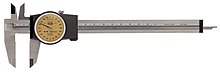
Instead of using a vernier machinery, which requires some practice to use, the punch caliper reads the last fraction of a millimeter or inch on a simple dial.
In this instrument, a minor, precise rack and pinion drives a pointer on a circular dial, allowing direct reading without the need to read a vernier scale. Typically, the pointer rotates once every inch, tenth of an inch, or 1 millimeter. This measurement must be added to the fibroid whole inches or centimeters read from the slide. The punch is usually arranged to be rotatable below the pointer, allowing for "differential" measurements (the measuring of the difference in size between two objects, or the setting of the dial using a principal object and subsequently being able to read directly the plus-or-minus variance in the size of subsequent objects relative to the master object).
The slide of a dial caliper can usually be locked at a setting using a small lever or screw; this allows simple go/no-get checks of part sizes.
Digital caliper [edit]
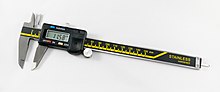
A popular refinement replaces the analog dial with an electronic brandish that shows the reading as a numeric value. Rather than a rack and pinion, these calipers utilise a linear encoder. About digital calipers can exist switched between centimeters or millimeters, and inches. All provide for zeroing the brandish at any betoken along the slide, allowing the aforementioned sort of differential measurements equally with the dial caliper. Digital calipers may contain a "reading hold" characteristic, allowing the reading of dimensions later on utilise in awkward locations where the display cannot exist seen. Ordinary 6-inch (150 mm) digital calipers are made of stainless steel, have a rated accurateness of 0.001 in (0.02 mm) and a resolution of 0.0005 in (0.01 mm).[eight] The aforementioned engineering is used to brand longer 8-inch and 12-inch calipers; the accuracy for longer measurements declines to 0.001 in (0.03 mm) for 100–200 mm and 0.0015 in (0.04 mm) for 200–300 mm.[9]
Increasingly, digital calipers offering a serial data output to permit them to be interfaced with a dedicated recorder or a personal computer. The digital interface significantly decreases the time to make and record a serial of measurements, and it too improves the reliability of the records. A suitable device to catechumen the series data output to common estimator interfaces such every bit RS-232, Universal Serial Bus, or wireless can be congenital or purchased. With such a converter, measurements tin can exist direct entered into a spreadsheet, a statistical process control program, or similar software.
The serial digital output varies among manufacturers. Mutual options are
- Mitutoyo's Digimatic interface. This is the dominant name brand interface. Format is 52 bits arranged every bit 13 nibbles.[10] [eleven] [12]
- Sylvac interface. This is the common protocol for inexpensive, not-proper name brand, calipers. Format is 24 bit ninety kHz synchronous.[xiii] [14]
- Starrett[fifteen]
- Brownish & Sharpe[xv]
- Federal
- Tesa[15]
- Aldi. Format is seven BCD digits.[14]
- Mahr (Digimatic, RS232C, Wireless FM Radio, Infrared and USB)[xvi]
Like punch calipers, the slide of a digital caliper can usually be locked using a lever or thumb-screw.
Some digital calipers comprise a capacitive linear encoder. A pattern of bars is etched directly on the printed excursion board in the slider. Nether the scale of the caliper another printed circuit lath also contains an etched pattern of lines. The combination of these printed circuit boards forms ii variable capacitors. The two capacitances are out of phase. As the slider moves the capacitance changes in a linear manner and in a repeating blueprint. The circuitry built into the slider counts the confined equally the slider moves and does a linear interpolation based on the magnitudes of the capacitors to find the precise position of the slider. Other digital calipers contain an inductive linear encoder, which allows robust performance in the presence of contagion such as coolants.[17] Magnetic linear encoders are used in notwithstanding other digital calipers.
Micrometer caliper [edit]
A caliper using a calibrated screw for measurement, rather than a slide, is called an external micrometer caliper gauge, a micrometer caliper or, more often, simply a micrometer. (Sometimes the term caliper, referring to any other type in this commodity, is held in contradistinction to micrometer.)
Comparison [edit]
Each of the above types of calipers has its relative claim and faults.
Vernier calipers are rugged and have long-lasting accuracy, are coolant proof, are non afflicted by magnetic fields, and are largely shockproof. They may have both centimeter and inch scales. However, vernier calipers require good eyesight or a magnifying drinking glass to read and can exist difficult to read from a distance or from bad-mannered angles. Information technology is relatively piece of cake to misread the last digit. In production environments, reading vernier calipers all twenty-four hour period long is error-prone and is annoying to the workers.
Dial calipers are comparatively easy to read, especially when seeking the exact center past rocking and observing the needle movement. They can exist gear up to 0 at any point for comparisons. They are unremarkably fairly susceptible to shock harm. They are too very prone to getting dirt in the gears, which tin cause accurateness problems.
Digital calipers switch easily between centimeter and inch systems. They tin can exist prepare to zero hands at any point with a total count in either direction and can have measurements even if the display is completely hidden, either by using a "concord" central, or by zeroing the display and closing the jaws, showing the correct measurement, but negative. They can exist mechanically and electronically fragile. About also require batteries and do not resist coolant well. They are besides merely moderately shockproof and tin be vulnerable to dirt.
Calipers may read to a resolution of 0.01 mm or 0.0005 in, only accuracy may not be better than about ±0.02 mm or 0.001 in for 150 mm (6 in) calipers, and worse for longer ones.[18]
Utilize [edit]
Using the vernier caliper

A biologist uses calipers to measure the length of a bird'south leg
A caliper must be properly applied confronting the part in guild to take the desired measurement. For case, when measuring the thickness of a plate a vernier caliper must be held at right angles to the piece. Some practice may exist needed to measure out round or irregular objects correctly.
Accurateness of measurement when using a caliper is highly dependent on the skill of the operator. Regardless of type, a caliper's jaws must be forced into contact with the part beingness measured. As both part and caliper are always to some extent elastic, the amount of strength used affects the indication. A consistent, business firm bear on is correct. Too much forcefulness results in an under indication as function and tool distort; too little force gives insufficient contact and an over indication. This is a greater trouble with a caliper incorporating a wheel, which lends mechanical reward. This is especially the example with digital calipers, calipers out of adjustment, or calipers with a poor quality beam.
Simple calipers are uncalibrated; the measurement taken must be compared against a scale. Whether the scale is role of the caliper or non, all analog calipers—verniers and dials—require good eyesight in gild to achieve the highest precision. Digital calipers have an advantage in this area.
Calibrated calipers may exist mishandled, leading to loss of zero. When a calipers' jaws are fully closed, it should, of form, bespeak zero. If it does non, it must exist recalibrated or repaired. A vernier caliper does not easily lose its calibration only a sharp impact or accidental damage to the measuring surface in the caliper jaw tin can exist significant enough to displace zero.[19] Digital calipers accept zero ready buttons, for quick recalibration.
Vernier, punch and digital calipers tin be used with accessories that extend their usefulness. Examples are a base of operations that extends their usefulness as a depth gauge and a jaw attachment that allows measuring the heart altitude between holes. Since the 1970s a clever modification of the moveable jaw on the dorsum side of whatsoever caliper allows for step or depth measurements in addition to external caliper measurements, in similar fashion to a universal micrometer (due east.g., Starrett Mul-T-Anvil or Mitutoyo Uni-Mike).
Zippo error [edit]
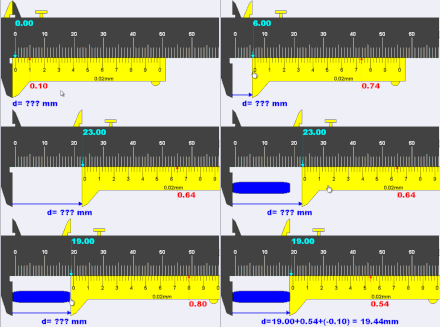
When the jaws are closed and if the reading is 0.x mm, the zero error is referred to as +0.10 mm. The method to use a vernier scale or caliper with nada error is to employ the formula "(actual reading) = (master scale) + (vernier scale) − (zippo fault)", thus the bodily reading is 19.00 + 0.54 − (0.10) = 19.44 mm. The resolution of the measurement, based on the width of the smallest sub-interval, is ±0.02 mm.
The method to use a vernier scale or caliper with zero mistake is to use the formula "actual reading = main scale + vernier scale − (zero mistake)". Zilch error may arise due to knocks that affect the calibration at 0.00 mm when the jaws are perfectly closed or but touching each other. Positive zero error refers to the fact that when the jaws of the vernier caliper are merely closed, the reading is a positive reading away from the actual reading of 0.00 mm. If the reading is 0.10 mm, the zero error is referred to as +0.10 mm. Negative null error refers to the fact that when the jaws of the vernier caliper are just closed, the reading is a negative reading away from the actual reading of 0.00 mm. If the reading is −0.08 mm, the nothing error is referred to as −0.08 mm.
See too [edit]
- Cruising rod
- Punch indicator
- Lens clock
- Pace stick
Notes [edit]
- ^ The 10th day of the 60-day cycle.
- ^ Lit. "the day of the new moon."
- ^ Shijianguo is the first era name of Wang Mang, the showtime and simply emperor of the Xin dynasty, lit. "the beginning of a nation's establishment."
References [edit]
- ^ Mensun Spring: The Giglio wreck: a wreck of the Archaic menses (c. 600 BC) off the Tuscany island of Giglio, Hellenic Institute of Marine Archeology, Athens 1991, pp. 27 and 31 (Fig. 65)
- ^ a b Roger B. Ulrich: Roman woodworking, Yale University Printing, New Haven, Conn., 2007, ISBN 0-300-10341-7, p.52f.
- ^ "hand tool." Encyclopædia Britannica from Encyclopædia Britannica 2006 Ultimate Reference Suite DVD. [Accessed July 29, 2008]
- ^ Colin A. Ronan; Joseph Needham (24 June 1994). The Shorter Scientific discipline and Civilisation in China: 4. Cambridge University Press. p. 36. ISBN978-0-521-32995-8.
adaptable outside caliper gauge... self-dated at AD 9
. An abridged version. - ^ "Bronze Caliper of the Wang Mang Regime". Cultural-Red china.com. Archived from the original on 2014-08-31. Retrieved 2013-11-26 .
- ^ http://world wide web.mackinmfg.com/
- ^ "Slide Calipers" (PDF). Starrett.com. Archived from the original (PDF) on 2010-05-25. Retrieved 2010-06-25 .
- ^ "Harbor Freight Tools – Quality Tools at Disbelieve Prices Since 1977". world wide web.harborfreight.com.
- ^ "Digital Caliper". MSI-Viking.com. Archived from the original on 2007-07-26. Retrieved 2009-06-12 .
- ^ DRO Arrangement: Linear Scales & Counters (PDF), Mitutoyo, n.d., p. 22, Bulletin No. 1715, archived from the original (PDF) on 2013-xi-03
- ^ Linear Gage (PDF), Mitutoyo, north.d., p. 33, Itemize No. E4174-542/572/575, archived from the original (PDF) on 2013-11-03
- ^ Lancaster, Don (February 2000), "Tech Musings" (PDF), Tech Musings, 145
- ^ "Chinese Scales". www.shumatech.com.
- ^ a b "Protocols of Digital Scales". Yadro.de. Archived from the original on 2013-12-09.
- ^ a b c Lancaster, Don (November 1999), "Tech Musings" (PDF), Tech Musings, 142: 142.3
- ^ "New Mahr 2015 Catalogue". world wide web.Cutwel.co.united kingdom of great britain and northern ireland. Cutwel.
- ^ ABS Coolant Proof Caliper; Coolant Proof Micrometer (PDF), Mitutoyo, Jan 2005, Message No. 1813-293/500, archived from the original (PDF) on 2013-xi-03
- ^ "Accuracy of Calipers". www.tresnainstrument.com.
- ^ Mitutoyo. E 12024 Check Points For Measuring Instruments. pp. two, 3.
External links [edit]
 | Wikimedia Commons has media related to Calipers. |
- RS-232 Interface Design Details For Digital Caliper
Source: https://en.wikipedia.org/wiki/Calipers
0 Response to "Can Caliper Read Both English and Metric ?"
Post a Comment